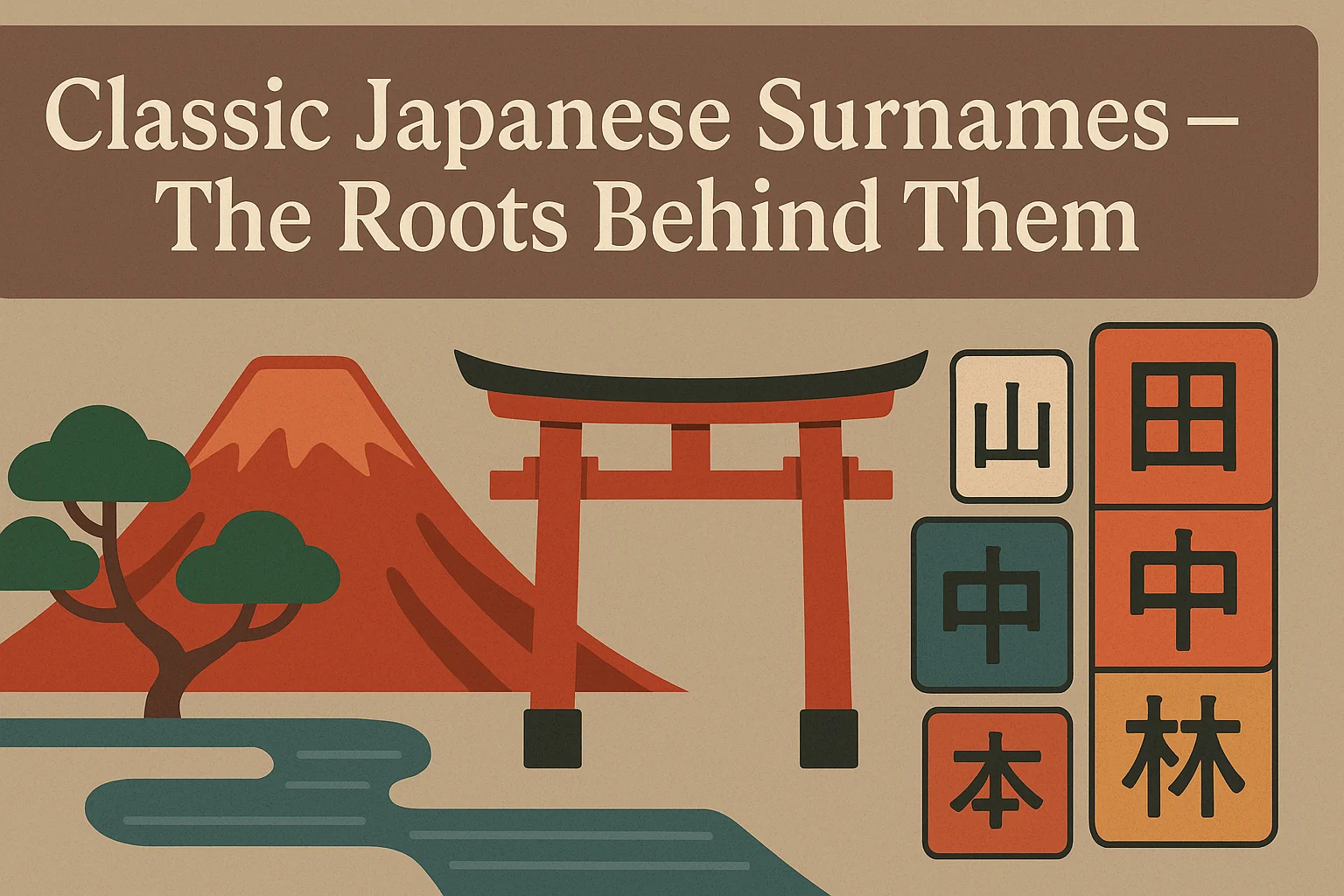
Classic Japanese Surnames – The Roots Behind Them
When I first started exploring Japanese heritage, I realized how strongly their culture, traditions, and ancestry shape the creation of names. Many Japanese surnames come directly from mountains, rivers, the sea, forests, and even animals, giving them a deeply poetic and spiritual feel. As someone who has spent years studying naming systems, I’ve noticed that these surnames often reflect ancient clan ties, past occupations, and meaningful geography.
Their written language, especially kanji, carries layers of symbolism, undertones, and beliefs that reveal the depth and beauty of a family’s background. Some names feel mysterious, others feel dark, and many hold a sense of timeless legacy that blends advancement and old-world identity in a way I’ve always admired.
During my own research, I worked through a curated list of popular, rare, common, and even cool surnames to understand how these identifiers function in daily life. I found that each one acts as a cultural reflection a quiet reminder of Japan’s complex history, deep legacies, and the subtle connection between people and nature.
Exploring different lists helped me appreciate how every identifier, whether chosen for a character, study project, or personal interest, is tied to meaningful meanings that shape identity. While reviewing one article after another, I realized that even the first name segment of a family’s identity often hints at the same elements—beings, regions, beliefs, and stories that define the heart of Japan.
This journey taught me that understanding these surnames is not just about naming but about recognizing the living thread that connects individuals to a much wider cultural story.
A Closer Look At Their Roots
When I first began studying Japanese last names, I was fascinated by how deeply they connect to nature, meanings, and old traditions from Japan, mainland Asia, and China. While learning to read kanji, its writing, symbol writing, Chinese characters, syllabary, consonant, vowel, symbol, and word patterns, I started paying attention to how families express their stories through names like Satō, Suzuki, Takahashi, Tanaka, Watanabe, Itō, Nakamura, Ohara, Sato, Maki, Yamamoto, Ito, Tanaka, and Nakamura again in their popular everyday use.
Many of these come from geographical references, occupational references, and descriptive terms, rooted in things like rice field, tree, bell, bridge, wisteria, high, tall, middle, inside, cross over, border, area, village, and even this or center rice paddy. My language mentors often explained how these layered meanings reflect the influence of different cultures and religions, making each choice feel both personal and historical.
Even modern Japanese-American families keep names with strong ties to their heritage, which I noticed while comparing how pronunciation and interpretation shift across communities. As I researched further, I found myself drawn to lesser-known surnames like Adachi, tied to samurai history and famous artists such as Osamu Adachi and Yumi Adachi, and names like Aguni, linked to A, Awa, foxtail millet, Guni, and country origins.
My field notes include names shaped by landscapes Akamine (“red peak”), widely heard in western Japan and the Ryukyu Islands; Amano, linked to heaven field and artists like Fabio Amano, a well-known tattoo artist; Ando, meaning peaceful wisteria; and Bando, tied to eastern Japan, the Osaka province, and the idea of being east of the slope. I still remember meeting a family named Chinen, who told me about its meanings one thousand years and feelings depending on the region.
Others, like Chino, relate to a field of miscanthus reeds, or the old name Chinu, meaning strange or unusual. Water-related names such as Fujikawa (“wisteria river”) and lineage-based names like southern Fujiwara appear often in registries I reviewed, while Fujiki, describing a tree where wisteria flower grow, captured how poetic Japanese naming can be.
Understanding The Structure Of Japanese Surnames
Understanding the structure of japanese last names is very important. After this you can understand the story behind each name.
Key Linguistic Elements
- kanji, writing, syllabary, symbol, Chinese characters
- layered meanings, language, symbol writing
- consonant, vowel, word patterns
Cultural & Historical Influences
- Japan, mainland Asia, China
- cultures, religions
- samurai, southern Fujiwara
Popular & Common Japanese Surnames
Japanese surnames carry rich history and cultural significance. Many have been passed down for generations and often reflect geography, nature, or family heritage. Here’s a look at some of the most popular and commonly used Japanese surnames.
Widely Used Names
Widely used surnames are not only common in daily life but also deeply tied to Japan’s cultural identity. These names have been passed down through generations, often rooted in nature, geography, or traditional roles within society. Because they appear across different regions, schools, and workplaces, they become familiar markers of Japanese history and everyday connection.
Many of these surnames carry meanings that reflect landscapes, family heritage, or poetic elements of the Japanese language. Their simplicity, beauty, and strong cultural presence are the reasons they remain so widespread today.
- Sato (佐藤) – One of the most common surnames in Japan, often linked to attendants or helpers.
- Suzuki (鈴木) – Meaning “bell tree,” a name that stands out for its natural and symbolic imagery.
- Takahashi (高橋) – “High bridge,” commonly found across the country and tied to both geography and tradition.
- Tanaka (田中) – “Rice field in the middle,” a classic agricultural-rooted family name.
- Watanabe (渡辺) – Meaning “crossing the border or area,” often tied to people living near waterways.
- Ito (伊藤) – Interpreted as “this wisteria,” combining simplicity with elegance.
- Nakamura (中村) – “Middle village,” a name connected to community-centered living.
Japanese-American Variants
Japanese-American surnames give a unique glimpse into how cultural identity is preserved across continents. When Japanese families immigrated to the United States, many kept their original surnames as a way to stay connected to their heritage, even as pronunciation and spelling adapted to Western environments.
These names often blend traditional Japanese meanings with the experiences of life abroad, becoming symbols of both cultural pride and generational history. Over time, they have become familiar within Japanese-American communities, schools, and businesses, carrying stories of migration, resilience, and family legacy.
- Ohara (大原) – Meaning “large field,” this name is widely found among Japanese families who settled on the West Coast.
- Sato (佐藤) – One of the most common surnames maintained by Japanese-American families, preserving its historical meaning of “assistant” or “attendant.”
- Maki (真木 / 槙) – Often interpreted as “true tree” or “evergreen,” this name reflects a strong natural heritage that remains popular abroad.
- Yamamoto (山本) – Meaning “base of the mountain,” it remains a well-recognized surname among long-established Japanese-American communities.
- Nakamura (中村) – “Middle village,” a name frequently passed down through Japanese-American generations, often unchanged from its original form.
- Tanaka (田中) – “Middle rice field,” carried by many immigrant families, especially those connected to early agricultural work in Hawaii and California.
- Ito (伊藤) – “This wisteria,” a poetic surname that has remained common in Japanese-American households for over a century.
Meaning-Based Categorization
Japanese surnames are more than just identifiers—they often carry deep meanings linked to nature, landscapes, occupations, or family traits. By examining the significance behind each name, we can categorize them into meaningful groups that reflect the cultural and historical values of Japan.
This approach helps us understand not just the names themselves, but also the stories and traditions they represent.
Nature-Related
Japanese nature-related surnames reflect how strongly people were connected to the natural world around them. Many families once lived near forests, rivers, mountains, or fields, and their surroundings became part of their identity.
These names often describe elements like plants, animals, water, or land features, and they carry calm, poetic meanings that highlight the beauty of Japan’s landscape.
Even today, these surnames feel timeless because they preserve the bond between daily life and nature that has shaped Japanese culture for centuries.
- Kobayashi (小林) – “small forest”
- Hayashi (林) – “forest”
- Matsumoto (松本) – “base of the pine tree”
- Morita (森田) – “forest rice field”
- Ueda (上田) – “upper rice field” (linked to cultivated land)
- Ishikawa (石川) – “stone river”
- Mizuno (水野) – “water field”
- Kawahara (河原) – “river plain”
- Takagi (高木) – “tall tree”
- Fujisawa (藤沢) – “wisteria swamp”
- Ohara (大原) – “large field/plain”
- Noguchi (野口) – “field entrance”
- Yamamoto (山本) – “base of the mountain”
Geographic / Location-Based
Geographic and location-based Japanese surnames often come from the landscapes, directions, and natural surroundings that shaped everyday life in old Japan. Families were frequently identified by the mountain they lived near, the river that ran through their village, or the fields they worked on.
These names described where a family came from, making it easier to recognize their community roots or regional ties. Over time, these simple place-based descriptions became lasting surnames that carry both historical meaning and a strong sense of identity.
Even today, many of these names offer a glimpse into how deeply geography shaped Japanese culture, traditions, and naming practices.
- Kawasaki (川崎) – “river cape”
- Kawaguchi (川口) – “river mouth”
- Yamashita (山下) – “below the mountain”
- Yamaguchi (山口) – “mountain entrance/mouth”
- Nakagawa (中川) – “middle river”
- Taniguchi (谷口) – “valley entrance”
- Minamida (南田) – “south field”
- Kitagawa (北川) – “north river”
- Nishimura (西村) – “west village”
- Higashiyama (東山) – “east mountain”
- Okada (岡田) – “hill rice field”
- Ueno (上野) – “upper plain/field”
- Shimoda (下田) – “lower rice field”
- Fujimoto (藤本) – “base of the wisteria” (often referencing a real geographic area)
- Harada (原田) – “field/plain rice field”
Occupational / Descriptive
Japanese occupational and descriptive surnames come from the jobs, roles, skills, or characteristics associated with a family long ago.
Many of these surnames were given to people based on the work they did farmers, merchants, artisans, soldiers or traits they were known for, such as being strong, dependable, or wise. Over generations, these simple descriptions turned into fixed family names.
These surnames reflect the practical, community-based lifestyle of historical Japan, where a person’s contribution to society became part of their identity.
Today, they offer a fascinating look into traditional occupations, social structures, and the everyday lives of people in the past.
- Sakai (酒井) – “wine well,” linked to sake brewers
- Inoue (井上) – “above the well,” often connected to well-keepers
- Kojima (小島) – “small island,” also used descriptively for people living on isolated land
- Okamura (岡村) – “hill village,” often given to families working or guarding hilly settlements
- Kudo (工藤) – “craftsman wisteria,” tied to artisans
- Hasegawa (長谷川) – “long valley river,” sometimes linked to families working across long valley routes
- Sato (佐藤) – originally tied to attendants or helpers
- Takagi (高木) – “tall tree,” sometimes used metaphorically to describe height or presence
- Shimada (島田) – “island rice field,” often tied to farming families
- Wada (和田) – “harmonious rice field,” given to farming communities
- Kaneko (金子) – “gold child,” historically linked to metalworkers or merchants
- Nomura (野村) – “field village,” sometimes tied to farming or land-managing roles
- Sugimoto (杉本) – “base of the cedar,” associated with woodworkers or forestry
Conclusion
Japanese surnames offer far more than simple identification they carry the weight of landscapes, family stories, occupations, beliefs, and centuries of cultural evolution.
Whether rooted in nature, shaped by geography, tied to ancient clans, or carried across oceans by Japanese-American families, each name holds a quiet depth that reflects the resilience and identity of the people behind it.
Exploring these surnames not only reveals the beauty of the language but also opens a window into Japan’s history, traditions, and the enduring connection between names and heritage.